|
PROBLEM
Measuring reflexive withdrawal to noxious stimulation in laboratory rodents is a mainstay of preclinical pain research. Testing is typically conducted on the hind paw. Most chronic pain models are designed to increase paw sensitivity through manipulations of the paw or of the nerves innervating the paw. Potential analgesics are tested for their ability to reverse that hypersensitivity. Notwithstanding caveats about inferring human pain perception from changes in rodent withdrawal reflexes, rodent pain models and the associated assessment of paw sensitivity continue to play a critical role in preclinical drug testing. But the technology and protocols used for testing pain behaviours likely contribute to the oft-cited reproducibility crisis and are overdue for fundamental improvements.
Assessing changes in paw sensitivity through changes in the threshold stimulus, withdrawal latency, or some other aspect of the behavior evoked by stimulating the paw is labour-intensive (low throughput) and poorly standardized. Stimuli are usually delivered by hand and responses measured by eye, which can introduce significant variability as well as bias if testers are not blinded to the treatment status of the animals. High-speed videography and machine learning are making analysis of behavioural responses more quantitative but this cannot overcome problems introduced by variability in stimulus delivery. Techniques such as optogenetics enable selective activation (or inhibition) of genetically defined cell types and photostimuli can be tightly controlled, thus offering an unprecedented opportunity to dissect the neural basis for behavior. Again, however, poorly controlled stimuli can be a limiting factor. Facing these challenges in our own experiments, we sought new ways to deliver stimuli more reproducibly and to measure the resulting behaviour in a precise yet cost-effective way.
SOLUTION
We have developed equipment to photonically stimulate mouse paws and automatically and precisely measure paw withdrawal for pain behavior testing. Our stimulator delivers blue light to activate channel rhodopsin, an optogenetic actuator, and infrared light to cause radiant heating. The aiming mechanism and automated withdrawal detection mechanism are novel. Photostimuli are aimed using red light delivered through a common light path. Red light provides visual feedback to aim the IR light, which is invisible to the human eye. Pre-targeting with red light also ensures that blue or IR photostimuli are already on target when initiated, which is crucial for accurately measuring response latencies. Reflectance of the red light, which decreases upon paw withdrawal, is measured and recorded to automatically assess response latencies with high temporal precision. All light beams are aligned and combined on a single sliding platform that is positioned under the mice. This new equipment delivers stimuli more reproducibly and with higher temporal precision than existing methods. Mechanical stimulation functionality is currently being developed and moreover, this stimulator is amenable to further automation such as computer-controlled aiming using machine learning, which will dramatically increase throughput with considerable benefits for the pharmaceutical industry.
|
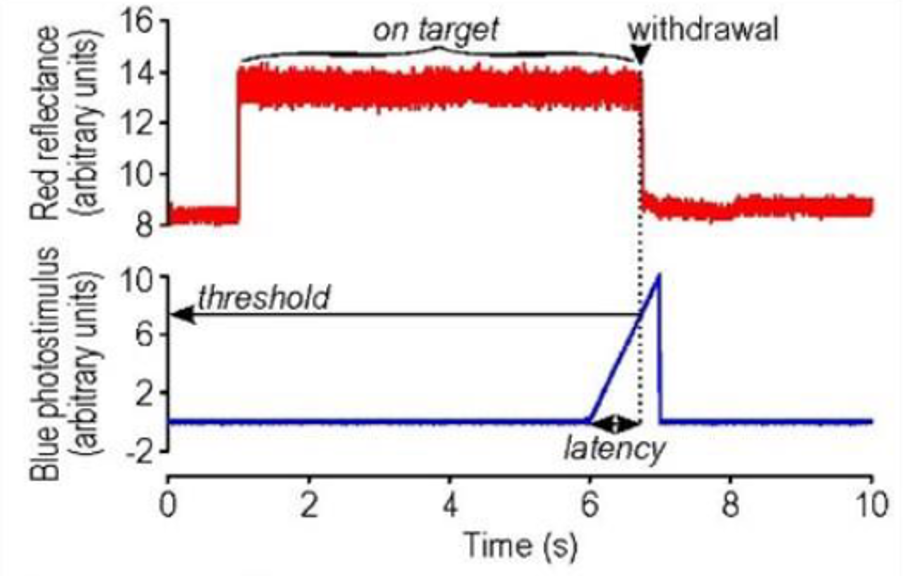 Figure 1. Sample response from mouse expressing ChR2 in nociceptive sensory neurons. Red reflectance is stable during pre-stimulus period and decreases when the mouse withdraws its paw 0.75 s after start of blue photostimulus.
|